 English
 Afrikaans
 Albanian
 Amharic
 Arabic
 Armenian
 Azerbaijani
 Basque
 Belarusian
 Bengali
 Bosnian
 Bulgarian
 Catalan
 Cebuano
 Chichewa
 Chinese (Simplified)
 Chinese (Traditional)
 Corsican
 Croatian
 Czech
Czech Danish
 Dutch
Dutch Esperanto
 Estonian
 Filipino
 Finnish
 French
 Frisian
 Galician
 Georgian
 German
 Greek
Greek Gujarati
 Haitian Creole
 Hausa
Hausa Hawaiian
 Hebrew
 Hindi
Hindi Hmong
Hmong Hungarian
 Icelandic
 Igbo
Igbo Indonesian
 Irish
Irish Italian
 Japanese
 Javanese
 Kannada
 Kazakh
 Khmer
Khmer Korean
 Kurdish (Kurmanji)
 Kyrgyz
 Lao
Lao Latin
Latin Latvian
 Lithuanian
 Luxembourgish
 Macedonian
 Malagasy
 Malay
Malay Malayalam
 Maltese
 Maori
Maori Marathi
 Mongolian
 Myanmar (Burmese)
 Nepali
 Norwegian
 Pashto
 Persian
 Polish
 Portuguese
 Punjabi
 Romanian
 Russian
 Samoan
 Scottish Gaelic
 Serbian
 Sesotho
 Shona
Shona Sindhi
 Sinhala
 Slovak
 Slovenian
 Somali
 Spanish
 Sudanese
 Swahili
 Swedish
 Tajik
Tajik Tamil
Tamil Telugu
 Thai
Thai Turkish
 Ukrainian
 Urdu
Urdu Uzbek
Uzbek Vietnamese
 Welsh
Welsh Xhosa
Xhosa Yiddish
 Yoruba
 Zulu
Zulu
So much of AAC instruction focuses on requesting, labeling, or sentence-building. These are important, but if we want students to connect with peers, we must also model greetings, jokes, comments, and conversation starters. Think:
- “Hi, what’s your name?”
- “That’s funny!”
- “Can I play too?”
- “Cool shirt!”
Use the student’s device to model these during real-life social moments — recess, snack time, group projects — and encourage others to do the same.
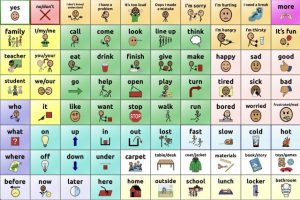
Pro Tip: Customize the device to have pre-programmed social buttons that are easily accessed. Modify the social page to contain socially appropriate phrases for the student’s age.
Include Emotion and Personality
AAC users need vocabulary that reflects who they are — not just what they need. I always encourage programming in favourite TV shows, silly phrases, personal opinions (“That’s boring!” or “I love pizza!”), and emojis or slang. Social connection grows when students can share themselves authentically.
Celebrate All Communication
Whether it’s a gesture, a glance at a symbol, or a full sentence from a device, all communication matters. Peers will follow the lead of the adults around them. When we slow down, give wait time, and treat AAC as a valid and natural form of interaction, we set the tone for inclusive friendship-building.
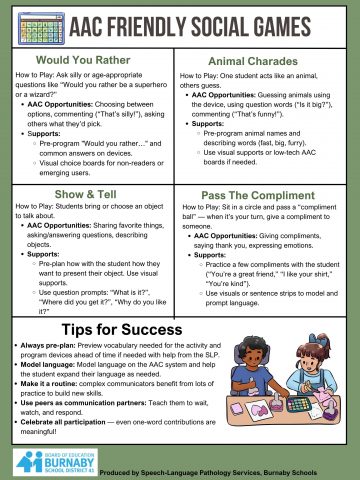
Check out some AAC Friendly Social Games to play and tips for success:
AAC Social Games – blog post (1)


 Reload document
  Open in new tab